


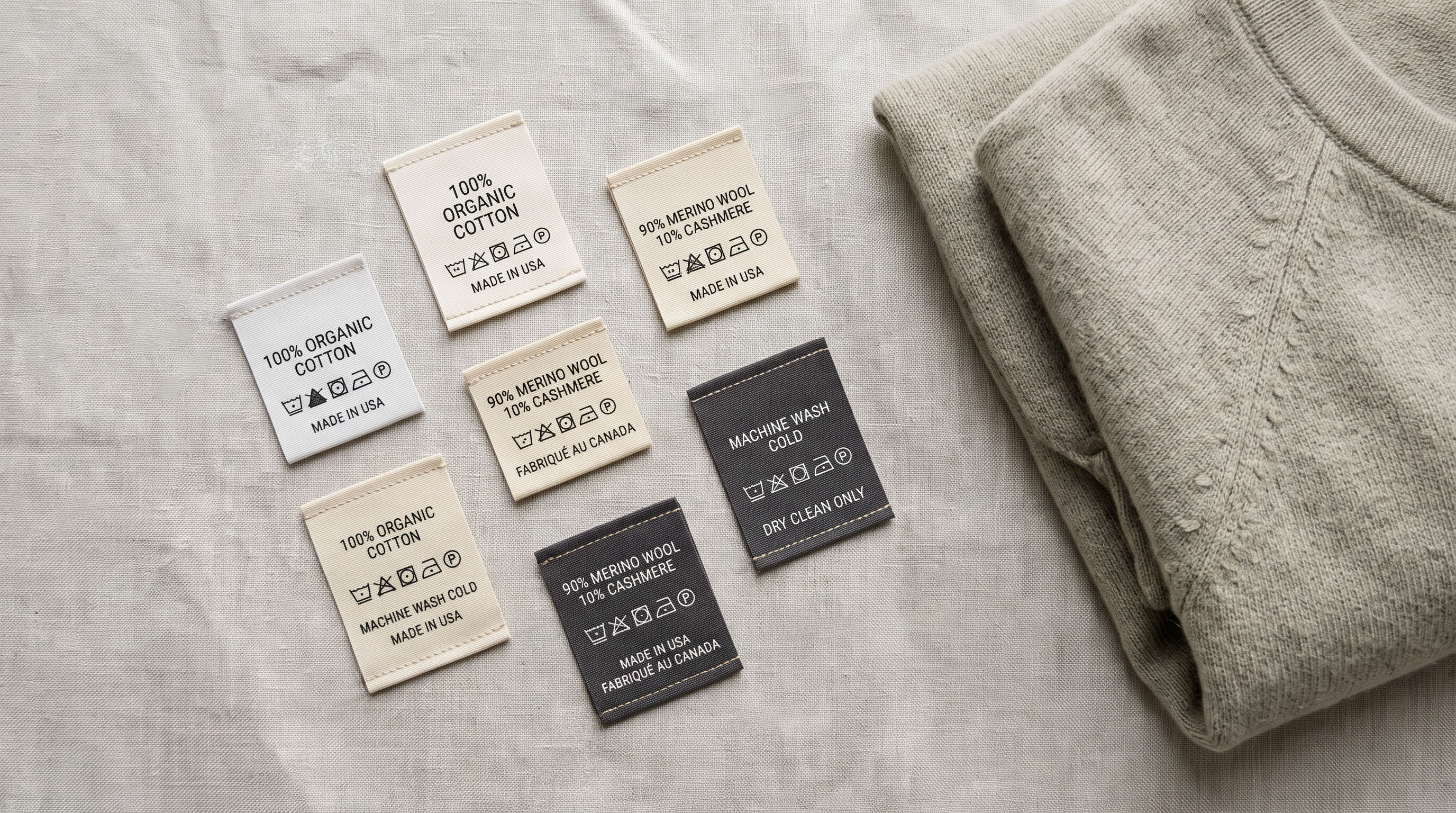
A production buyer at a uniform company sent us a care tag file last spring with eleven lines of text, four languages, a full row of care symbols and a 1.5 inch wide footprint. The artwork looked fine on screen. Woven at that size, the bottom three lines would have closed up into a grey smudge. We caught it at the proof stage, split the content across two labels, and the order shipped on time. The cost of finding that problem after 20,000 garments had been sewn would have been very different.
Care and content tags are the least glamorous label in a garment and the one most likely to cause a real business problem. A logo label that looks slightly off is a branding issue. A content tag with the wrong fiber percentage, a missing country of origin or care instructions that will not survive the first wash is a compliance issue, and retailers and marketplaces treat it that way. This guide covers what information typically belongs on custom woven tags, how to lay it out so it stays legible, and when a woven tag is the right product type versus a printed one.
What a Care and Content Tag Is Actually For
Brand labels tell the customer who made the garment. Care and content tags answer the questions a regulator, a retailer's compliance team and a customer standing at a washing machine will ask. In the United States, two sets of rules do most of the work for apparel sold to consumers.
The first is the Textile Fiber Products Identification Act, enforced by the Federal Trade Commission. It generally requires that textile garments disclose fiber content by generic fiber name and percentage by weight, the country of origin, and the identity of the manufacturer or another business responsible for the product. That identity is usually shown as either the company name or a Registered Identification Number, the RN you see on many tags.
The second is the FTC Care Labeling Rule. It requires that most textile wearing apparel carry care instructions on a label that is permanently attached and stays legible for the useful life of the garment. Those instructions need to cover a safe cleaning method, typically washing or dry cleaning, plus any warnings the consumer needs, such as "do not tumble dry" or "wash with like colors."
We are a label manufacturer, not a law firm, and the rules carry exceptions, product categories and details that matter. Your compliance team or the retailer's vendor manual has the final word. What we can tell you, having produced care and content labels for thousands of brands since 2008, is where the practical problems show up and how to design around them.
The Data Most Tags Need to Carry
For a typical garment sold in the US, a complete care and content tag usually includes the following blocks of information. Planning them as blocks, rather than as one long paragraph of text, makes the layout much easier to control.
Fiber content. Generic fiber names with percentages, listed in order of predominance by weight. "60% Cotton, 40% Polyester" rather than a trademarked fiber name on its own. If a garment has distinct sections, such as a body fabric and a lining, many brands list each section separately. This is the line most likely to change between styles, so it is also the line most likely to be copied incorrectly from a previous order.
Country of origin. "Made in the USA," "Made in Vietnam," and so on. For imported apparel with a neck, the FTC rules have specific expectations about where the origin disclosure appears, generally on the inside of the garment near the center of the neck or close to the brand label. That placement requirement often decides whether origin sits on the main brand label or on the care tag, so settle it before artwork is finalized.
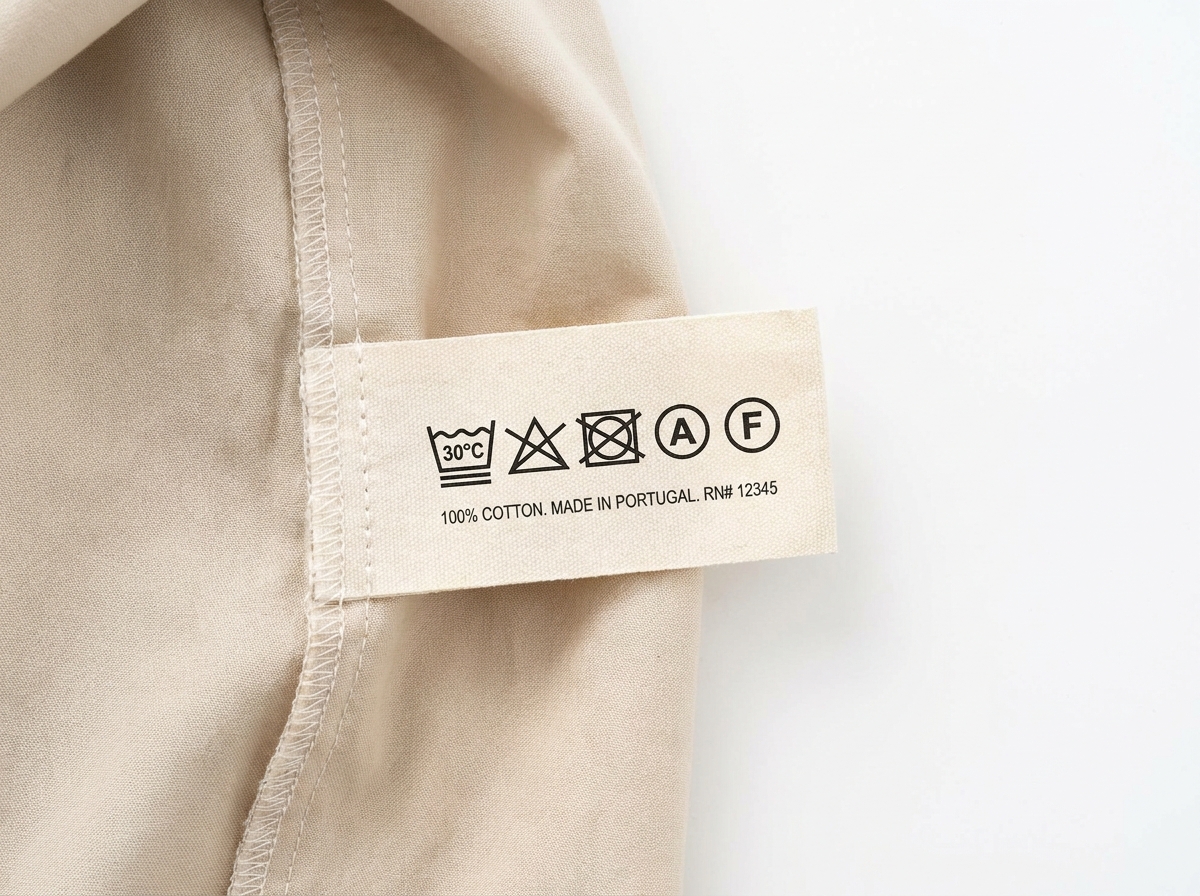
Manufacturer identity. Your company name or RN number. An RN is free to obtain from the FTC and keeps the tag shorter, which matters a great deal on a woven construction.
Care instructions. Washing, bleaching, drying, ironing and dry cleaning guidance. The Care Labeling Rule allows the standardized ASTM care symbols in place of words in the US, and many brands use a row of symbols with a short line of text for any warnings the symbols cannot express.
Size and style data. Not always regulated, but often requested by retailers and warehouses: size, style number, season code or lot. These are the fields that vary most from SKU to SKU, which affects how you order (more on that below).
If you sell into Canada, the EU or other markets, expect additional requirements such as bilingual or multilingual text, a Canadian CA number, or specific fiber naming conventions. Every added language roughly multiplies the text length, and that has direct consequences for the tag construction you choose.
Woven or Printed: Choosing the Right Construction
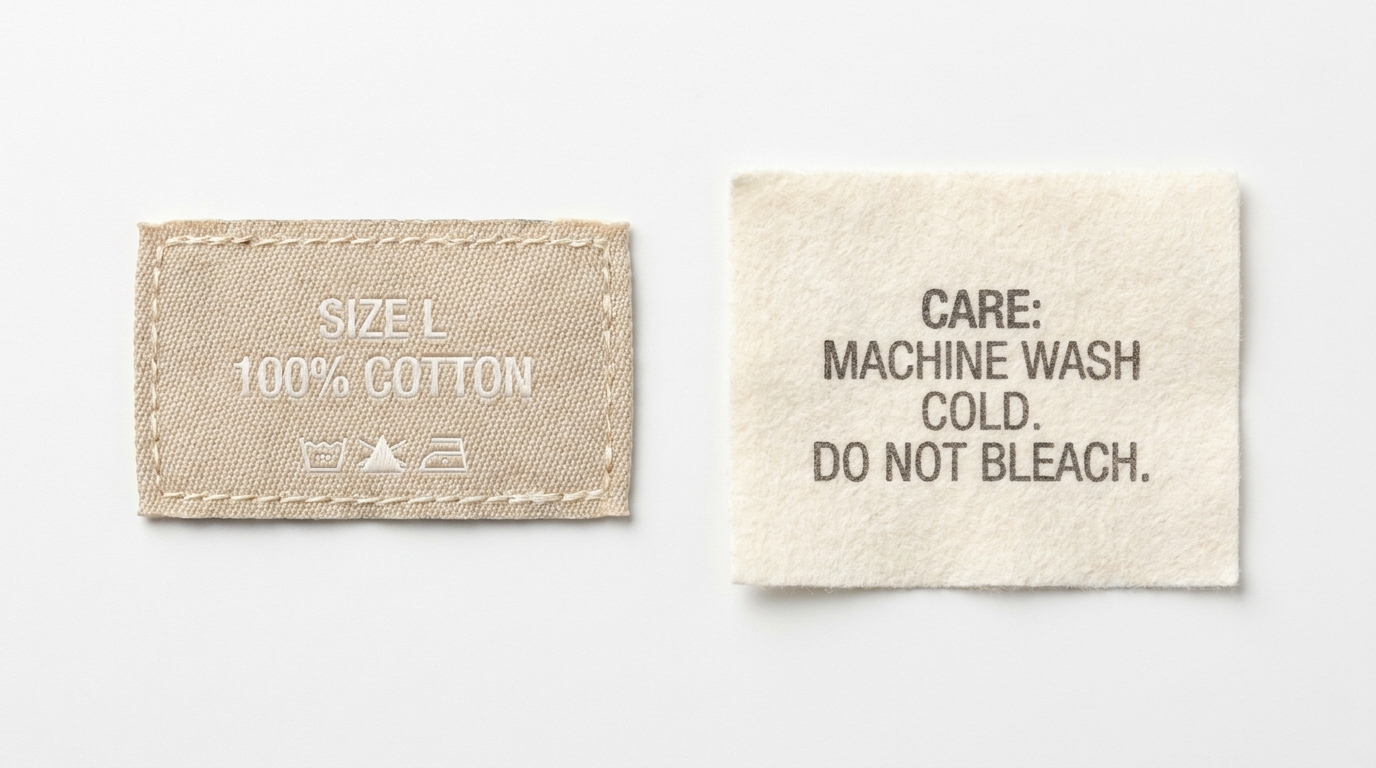
Custom woven labels are made on a loom: the text and symbols are formed by the weave itself, not printed on top. The woven label structure gives the labels two strong advantages for care content. The information cannot wash off, fade or crack, because it is part of the fabric, and the label reads as a premium detail when a customer turns the garment inside out. For garments that see heavy laundering, such as workwear, uniforms and hospitality apparel, the durability of woven labels works best.
The trade-off is text density. A woven tag has a physical resolution set by the thread count. Damask weaves, which use fine threads at high density, handle small text far better than woven satin, but even a high density damask has limits. Very small type, serif fonts with thin strokes, and tightly packed lines are where woven text starts to lose crispness. A short content tag with fiber, origin, RN and a row of care symbols is an excellent fit for woven labels. A four-language tag with several warnings may not be.
Printed tags trade a little permanence for far more room. Printed cotton labels are soft against the skin and hold fine type well, which makes them a common choice for multi-language content on basics, kids' wear and loungewear. Printed satin labels give a smooth, slightly lustrous finish and carry dense text cleanly, which suits lingerie, dresses and other lighter garments where a stiffer tag would be noticed.
A practical split we see often on larger projects: a woven brand label at the neck carrying the logo and country of origin, plus a printed care and content tag in the side seam carrying the long-form data. Each construction does the job it is best at, and the customer never feels a bulky tag at the collar.
Layout Rules That Keep Woven Tags Legible
Most problems with woven care tags are layout problems, not weaving problems. A few rules prevent nearly all of them.
Use a clean sans serif font. Simple, even-weight letterforms survive the weave. Thin serifs and hairline strokes tend to break up or disappear at small sizes.
Give lines room. Line spacing that looks generous on screen is usually right once woven. Tight leading is the most common reason adjacent lines bleed into each other.
Keep care symbols to one row. Five standard symbols in a single row is a clean, readable layout. Two rows of symbols on a narrow tag almost always reads as clutter.
Allow for the fold and the seam. A center-fold or end-fold tag loses some area to the fold and to the stitch line. Keep text out of the outer margin so nothing is sewn over. Your sewing contractor can tell you how much seam allowance they actually use; ask before artwork is final.
Use high contrast colors. Black on white, white on black, or navy on white read best. Low contrast combinations, such as grey on beige, can look elegant on a brand label but make a content tag hard to read under a laundry room light.
Our art team reviews every file before production and will flag text that is likely to close up at the size requested. That review is part of the free proof, and it is the cheapest point in the process to change anything.
Managing Variable Data Across SKUs
Brand labels are usually identical across a whole collection. Care and content tags are not. Fiber content changes between a cotton tee and a blended hoodie, origin can change between factories, and size or style codes change on every SKU. This is where ordering strategy matters.
The cleanest approach is to separate fixed data from variable data. Put the information that applies to the whole project, such as your RN, care symbols for a fabric family and origin for a given factory, on a shared tag design. Handle the variable information, such as size, either with a separate small size tab or with a short run of each version. Because we work with low minimums, starting at 5 pieces for labels, running several content versions in modest quantities is practical even for growing brands. Larger projects benefit from consolidating versions where the compliance data genuinely matches, which brings per-piece cost down.
Whichever approach you use, keep a single source of truth for content data. A simple spreadsheet listing each style with its fiber content, origin and the label version it uses will save hours at reorder time. Most content errors we see are not design errors; they are an old artwork file reused for a new style with a different fabric.
A Pre-Order Checklist for Production Buyers
Before you approve artwork for a care and content tag, run through these questions with your team:
Has the fiber content been confirmed against the mill's specification for this exact fabric, not a previous lot? Is the country of origin correct for the factory producing this run, and is it placed where the rules and your retailers expect? Is the RN or company name current? Do the care instructions match the fabric's tested performance, including any trims, prints or embellishments that are more delicate than the base fabric? Are all required languages included for every market the style will ship to? And has the sewing contractor confirmed the tag size, fold type and placement?
If any answer is uncertain, resolve it before the proof is approved. A corrected proof costs a day. A corrected production run costs far more, and relabeling finished goods is slow, expensive and occasionally impossible.
Getting Care Tags Right the First Time
Care and content tags will never be the label that sells your garment, but they are the label that protects it, in retailer audits, customs and through years of washing. Treat the content as data, choose the construction that fits the amount of text you need to carry, and let the proof stage do its job.
Send us your content, target size and garment type, and our team will recommend woven, printed cotton or printed satin construction and return a free quote and digital proof. With low minimums and fast turnaround, it is straightforward to get compliant, legible tags into production for a single style or a full line.
The information below is required for social login
Sign In
Create New Account