



Sustainability expectations in apparel have shifted significantly over the past several years. Buyers are asking more questions about material sourcing and retail partners have started requesting documentation on supply chain sustainability. Brands that once treated labels as an afterthought are now recognizing that even a small woven tag inside a collar is a material choice and holds weight.
For production buyers and brand managers evaluating their labeling options, the comparison between organic cotton and polyester woven labels is worth taking a look at. Both materials produce high-quality, durable labels. But they differ in how they're produced, how they perform across different applications, how they support sustainability positioning, and what they cost. Let us break it down for you.
Woven Labels: A Quick Production Overview
Before comparing materials, it's useful to understand what woven labels are and how the base material affects the final product. A woven label is produced on modern digital looms, which weave thread into a fabric substrate to produce text, logos, and graphics with precise definition. The thread that's woven into the label is the primary material, and that thread can be made from polyester, cotton, or other fiber blends.
We've been producing woven labels for apparel brands since 2008, working across product categories from performance activewear to luxury casualwear to uniform programs. The material choice question comes up regularly, and the answer is almost always "it depends on the application."
Polyester Woven Labels: The Production Standard
Polyester is the dominant material in woven label production, and for practical reasons. It's dimensionally stable, meaning it holds its shape through repeated washing without shrinking or distorting. It accepts color extremely well, producing vibrant, accurate thread colors that match brand color specifications consistently. It's resistant to moisture, which matters for garments that go through industrial laundering or high-use environments. And it's cost-effective at scale.
For production buyers sourcing labels at volume, polyester delivers the most predictable results. Color consistency is excellent across large production runs. The material performs reliably on automated sewing lines because it doesn't stretch or shift. Labels maintain their crisp appearance through years of washing under normal use conditions.
From a finish standpoint, polyester woven labels have a slight sheen, which is inherent to synthetic fiber. This sheen reads as polished and precise, which suits brands with a modern or technical aesthetic. For brands in the performance, workwear, or corporate uniform category, polyester's clean finish and durability profile are typically the right combination.
The material's sustainability profile is more complex. Standard polyester is petroleum-derived, which means it carries the environmental footprint associated with synthetic fiber production. Recycled polyester (rPET), made from post-consumer plastic, is increasingly available and offers meaningfully reduced embodied carbon relative to virgin polyester. For brands that want to maintain polyester's performance characteristics while addressing sustainability concerns, rPET labels are worth evaluating.
Organic Cotton Printed Labels: The Sustainable Alternative
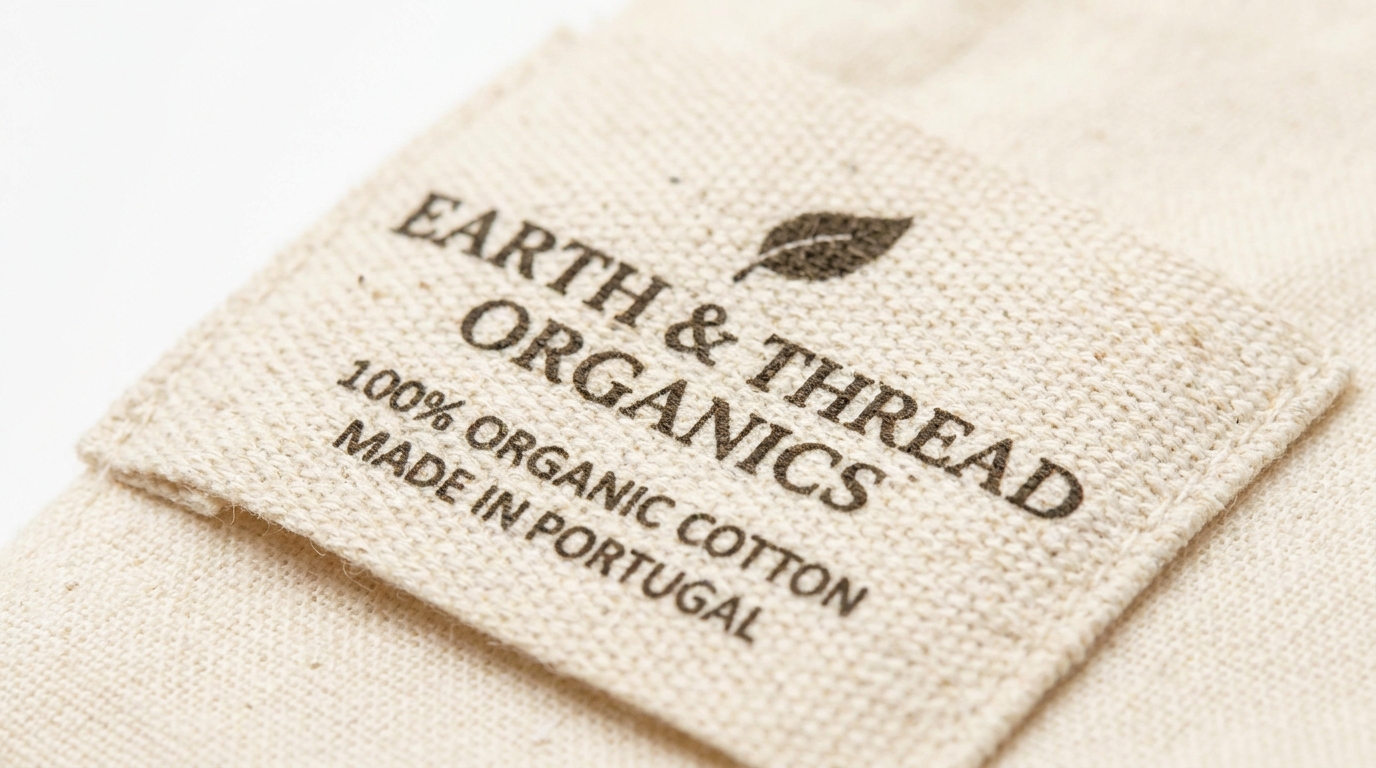
Organic cotton labels are made using a cotton twill substrate with the design screen printed onto the twill material. The cotton twill is sourced from suppliers certified to organic production standards, most commonly GOTS (Global Organic Textile Standard) or OCS (Organic Content Standard). These certifications verify that the cotton was grown without synthetic pesticides or fertilizers, and that the processing chain maintains traceability from source to finished goods.
The material feel is noticeably different from polyester. Cotton labels have a softer, more matte finish. They feel more like fabric than a standard synthetic label, which is an aesthetic quality some brands specifically want. For brands focused around natural materials, responsible sourcing, or organic product lines, a cotton label is a material choice that's consistent with the broader brand story. The label itself carries the same values as the garment.
Durability is solid for most apparel applications. Cotton labels hold up well through standard household washing cycles. For high-frequency industrial laundering environments, some polyester blends may outperform cotton over time, but for most consumer apparel, organic cotton labels perform reliably across the expected garment life.
The certification dimension is worth noting for brands with sustainability marketing commitments. Using GOTS or OCS-certified cotton labels gives brands a traceable material claim that can be used in sustainability reporting, hang tag messaging, or retail partner questionnaires. This is increasingly valuable as supply chain transparency requirements increase across retail channels.
Side-by-Side Comparison
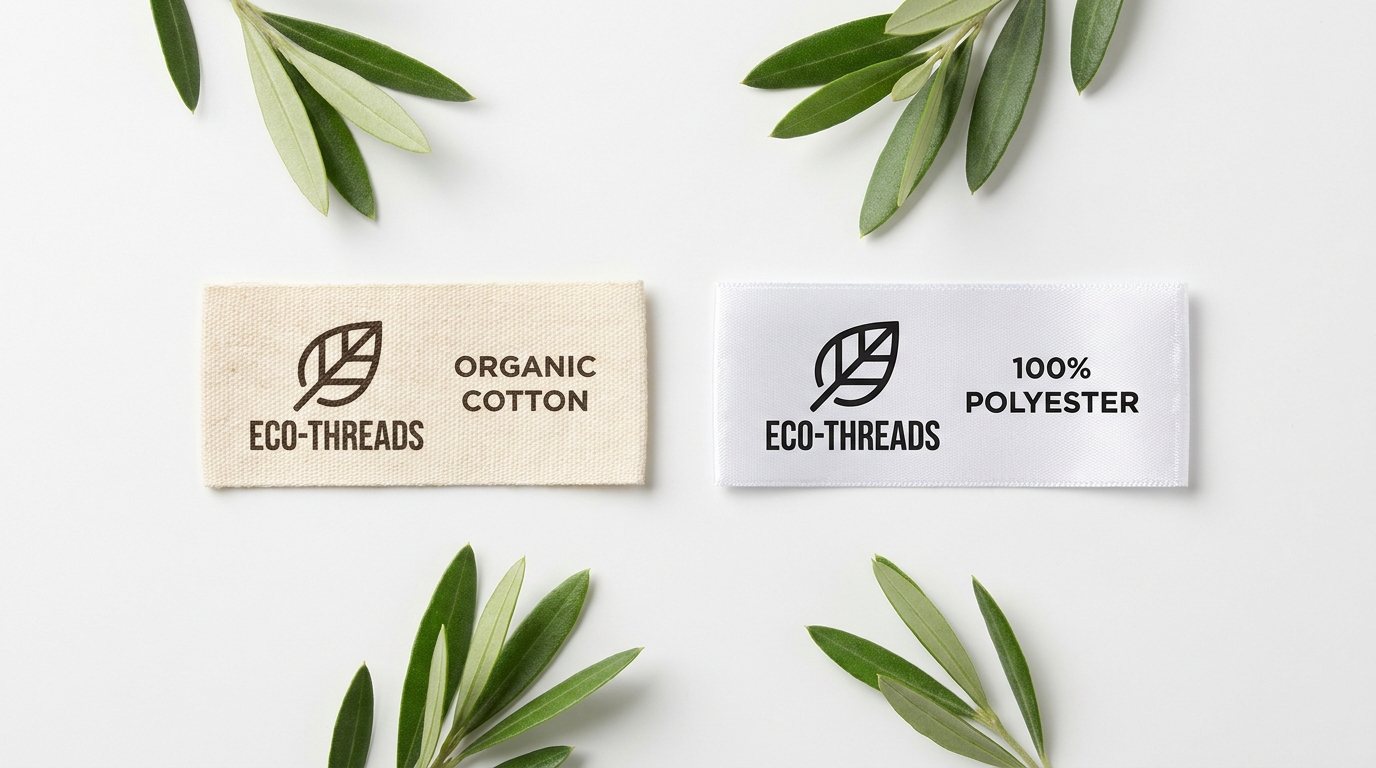
Sustainability: Organic cotton is the clear choice for verifiable eco-friendly claims, backed by recognized third-party standards like GOTS. Recycled polyester (rPET) helps reduce virgin plastic use, though it lacks the farm-level certification system of cotton. Standard polyester has the weakest environmental profile of the three.
Durability and Performance: Polyester excels in high-stress conditions, making it ideal for activewear, workwear, and garments washed frequently at high temperatures. Organic cotton offers more than enough durability for standard daily apparel, which covers what most brands produce.
Color accuracy: Polyester absorbs dye exceptionally well, delivering bright, vibrant tones and precise color matching. Organic cotton yields a softer, matte finish, resulting in accurate colors that naturally appear a bit more understated.
Tactile feel: Organic cotton feels soft against the skin, making it the best option for labels placed in sensitive areas like the inner neck. Polyester is slightly stiffer with a subtle sheen, which can feel less comfortable if worn directly against the body.
Cost: Standard polyester is the most budget-friendly option. Organic cotton carries a small price premium per label due to certified farming practices, which can add up on high-volume production orders.
Lead time: Both materials generally follow standard production schedules. Organic cotton may occasionally require a slight buffer depending on raw material availability, but normal planning accounts for this easily.
Which Material Is Right for You?
A few practical decision points:
If your brand has a strong and documented sustainability commitment and your garments are focused around natural or organic materials, organic cotton labels are the best choice. The label's material should match the garment's material. A certified organic cotton label provides a verifiable supply chain claim that can be harder with standard polyester.
If your production runs are high-volume, require the closest color matching, or involve garments subjected to industrial laundering, polyester (including rPET) remains the most reliable choice. The performance and consistency advantages are better when producing at scale.
If you're producing a line that blends sustainable positioning with performance requirements, a blended approach is viable: organic cotton labels for your core lifestyle or casualwear styles, polyester for performance or workwear categories. Many production buyers take this segmented approach.
If cost is the primary constraint and sustainability is secondary, standard polyester delivers the best price-performance ratio. There's no reason to specify organic cotton if the brand isn't using that material positioning, and doing so adds cost without a corresponding marketing benefit.
A Note on Label Placement and Construction
Material choice also interacts with how labels are attached. Iron-on backing is available for polyester woven labels but not for cotton labels. Sew-on is standard for both.
One consideration for organic cotton labels in particular: if the label will be sewn into a garment alongside other materials, confirm that the care and washing instructions for the garment are consistent with the cotton label's care requirements. Cotton and synthetic materials can behave differently under certain wash and dry conditions. This is mostly a non-issue for standard consumer apparel, but worth confirming for performance or technical garments.
Ordering Custom Labels
We produce both organic cotton and polyester woven labels starting at 5 pieces per order. Our team can provide samples of both materials if you need to evaluate tactile feel and finish before committing to a full production run.
For brands with sustainability requirements, we can provide documentation on material sourcing and certifications. For production buyers building out a label specification, we're happy to walk through the full material options and recommend based on your specific application.
Browse our full label catalog for all available label materials and styles.
The information below is required for social login
Sign In
Create New Account