

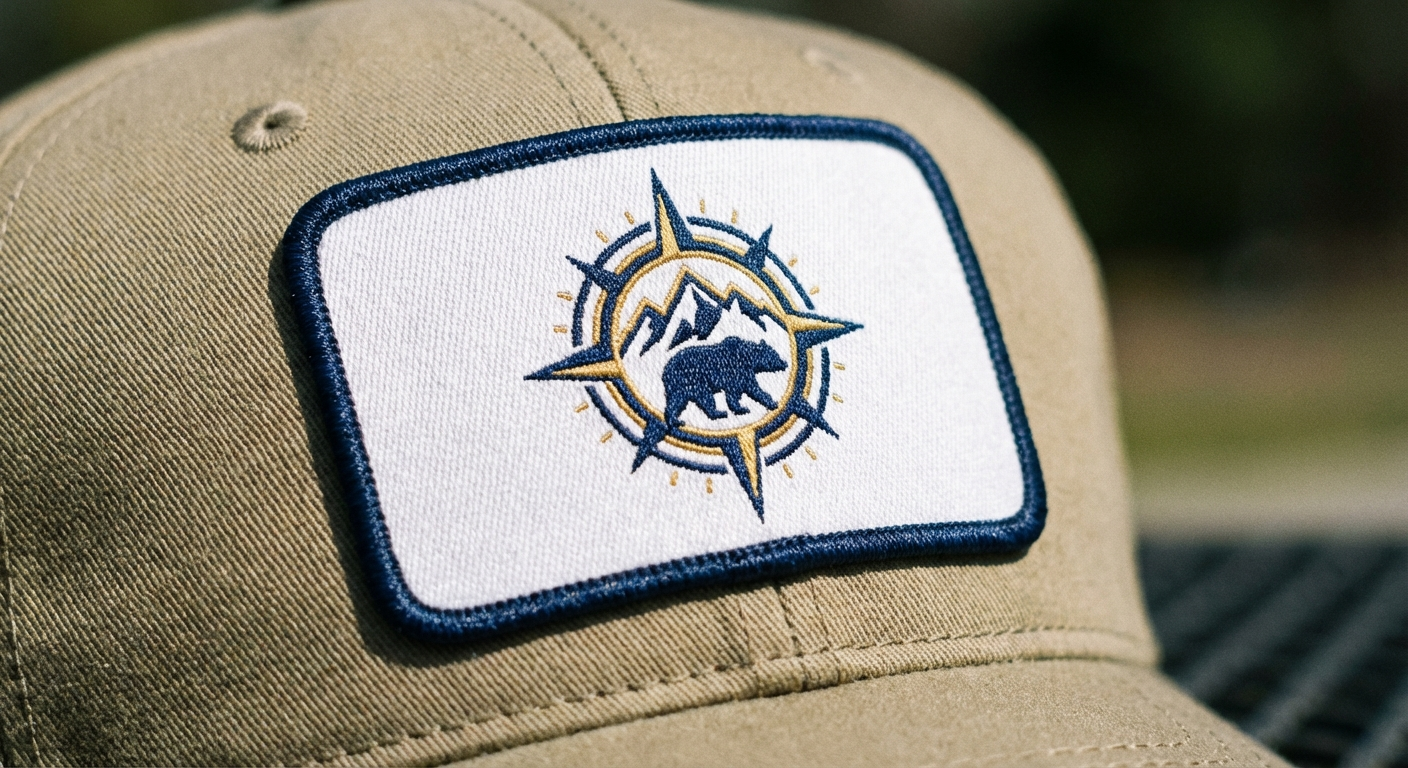
Last month a hat company ordered 25 custom woven patches from us. Twenty-five. Not 2,500, just twenty-five. They were testing a new logo for a limited drop and didn't want to commit to a larger run before seeing how the patch looked on their product. Three weeks later they came back for 500 more. That's exactly how it's supposed to work, and it's exactly why we keep our minimums at 5 pieces for woven patches.
If you're running a small brand like a clothing line, a hat company, a bag maker, or a craft business, custom woven patches are one of the highest-impact branding tools available to you. They're affordable, they're versatile, and they communicate a level of quality that printed alternatives simply don't match. Here's everything you need to know to order your first batch confidently.
Why Woven Patches (Not Embroidered)?
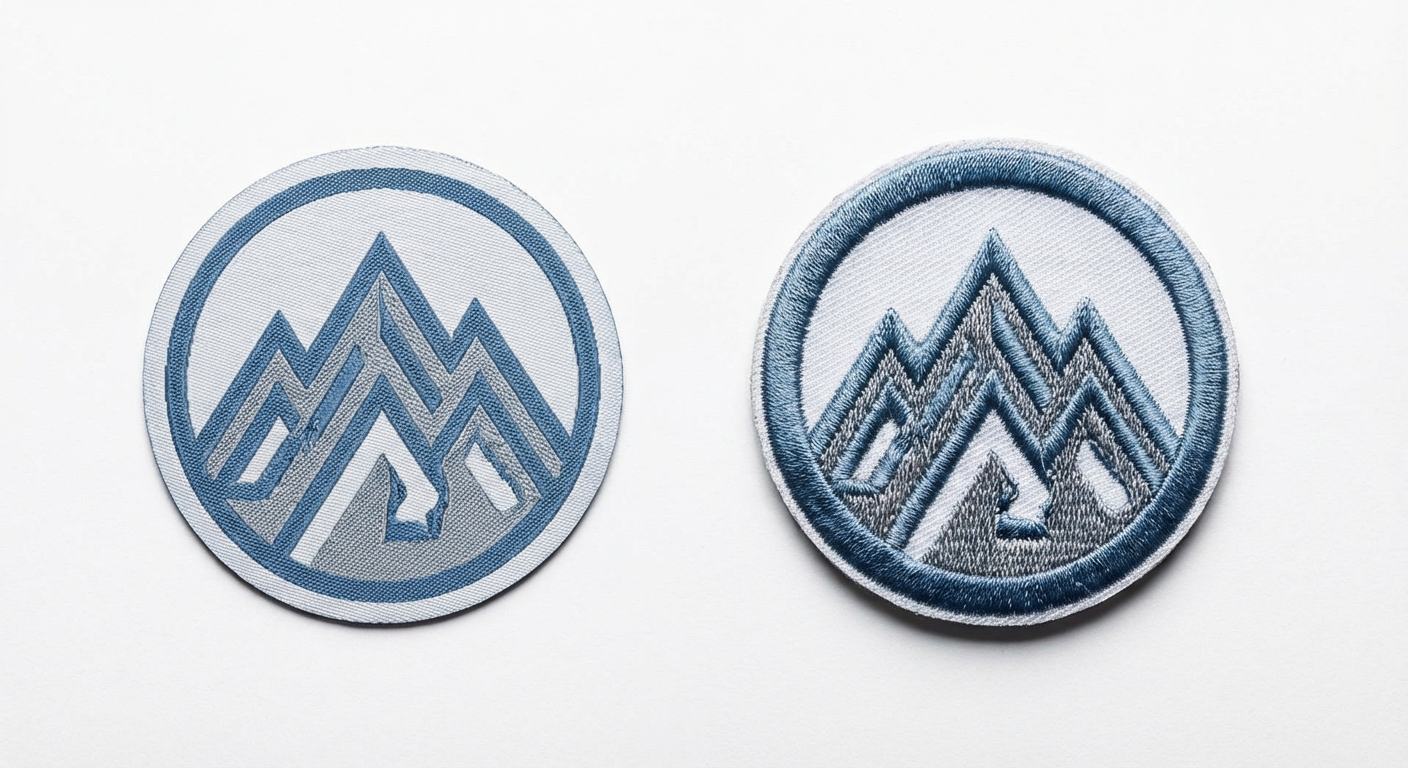
People mix these up constantly, so let's clarify. Embroidered patches are made with thick thread stitched onto a backing material. They have a raised, textured surface that you can feel with your fingertips. They're bold, they're chunky, and they look great on jackets and hats where that 3D texture is part of the appeal.
Woven patches are made on modern digital looms, the same looms used for woven labels. Thin threads are interlaced to create a flat, smooth surface with incredibly fine detail. The result is closer to a miniature fabric print than a stitched emblem.
For small brands, the distinction matters because of what each type can and can't do:
Detailed reproduction. Woven patches handle small text, thin lines, and complex logos with far more precision than embroidered patches. If your brand name is in a script font, or your logo has fine linework, woven will reproduce it cleanly where embroidery would blur it. Text as small as 2mm or 5pt is legible when woven. Embroidery needs at least 4-5mm or 12pt to stay readable.
Color range. Woven patches support up to 9-12 thread colors depending on the loom, and the colors blend visually because the threads are so fine. Embroidered patches work best with 6 or fewer distinct colors. Neither supports true gradients the way printing does, but woven gets closer.
Profile. Woven patches are flat on the garment. Embroidered patches are raised and add physical dimension. Neither is better; it all depends on the look you prefer. But woven patches are easier to sew over seams, tuck under folds, and apply to curved surfaces like hat crowns because they are flexible and thin.
Pricing. At small quantities (5-100 pieces), woven and embroidered patches are priced comparably. As quantities increase, woven patches tend to be slightly less expensive per unit because loom production is faster than embroidery-machine production for most designs.
Sizing Your Patches Right
Size is one of the first decisions you'll make, and it affects everything downstream — cost, visibility, placement options, and design legibility.
Here are the sizes we see most often, and what they're typically used for:
1" to 1.5": Small accent patches. Common on shirt cuffs, pocket corners, and hat sides. At this size, keep your design simple, a small logo mark or monogram works well. Full brand names with small font sizes get lost.
2" to 3": The sweet spot for most brands. Large enough to show your full logo with legible text, small enough to look proportional on hats, jackets, bags, and shirts. If you're ordering your first batch of woven patches, start here.
3.5" to 5": Statement patches for jacket backs, large bags, and display pieces. These are conversation pieces, people notice them. They are great for patches with slogans, detailed illustrations, or multi-element designs.
Backing Options for Every Application
The backing determines how your patch is applied to the garment. Small brands often overthink this, so here's a straightforward breakdown:
Iron-on (heat seal) backing has a layer of adhesive on the back that activates with heat. Press it onto the fabric with a household iron or heat press, and it bonds in place. It's the most popular option for small brands because customers can apply patches themselves without sewing. The bond is strong enough for most casual wear but may loosen after repeated heavy washing. Reinforcing the patch with a few stitches around the edge makes it permanent.
Sew-on (non-adhesive back) is the traditional approach. No adhesive. The patch gets stitched directly onto the garment by hand or machine. It's the most secure attachment method and works on any fabric, including ones that don't tolerate heat (leather, vinyl, nylon). Choose this for workwear, outerwear, and any application where the patch needs to survive years of hard use.
Velcro® (hook-and-loop) backing lets patches be attached and removed at will. The hook side goes on the patch; the loop side gets sewn to the garment. Popular with military, tactical, and outdoor brands that want interchangeable patch systems. Also great for uniforms where patches need to be removed for laundering.
Adhesive (sticker) backing uses a peel-and-stick adhesive. It's temporary — good for sampling, events, and packaging, but not meant for permanent garment application. Think of it as a positioning tool rather than a permanent attachment.
Our recommendation for small brands placing their first order: iron-on backing. It gives your customers the easiest application experience, works for hats, jackets, bags, and most fabrics, and can always be reinforced with stitching for heavy-duty garments.
Design Tips from Our Production Team
Our art team reviews every design before production and catches potential issues early. But you'll save time and revision rounds if you keep these guidelines in mind from the start:
Simplify for the size. A design that looks great on your computer screen at 4" wide may not work at 2" wide on a woven patch. Fine details get lost, thin lines merge together, and small text becomes unreadable. When in doubt, simplify. Your logo's simplest version is usually the best patch design.
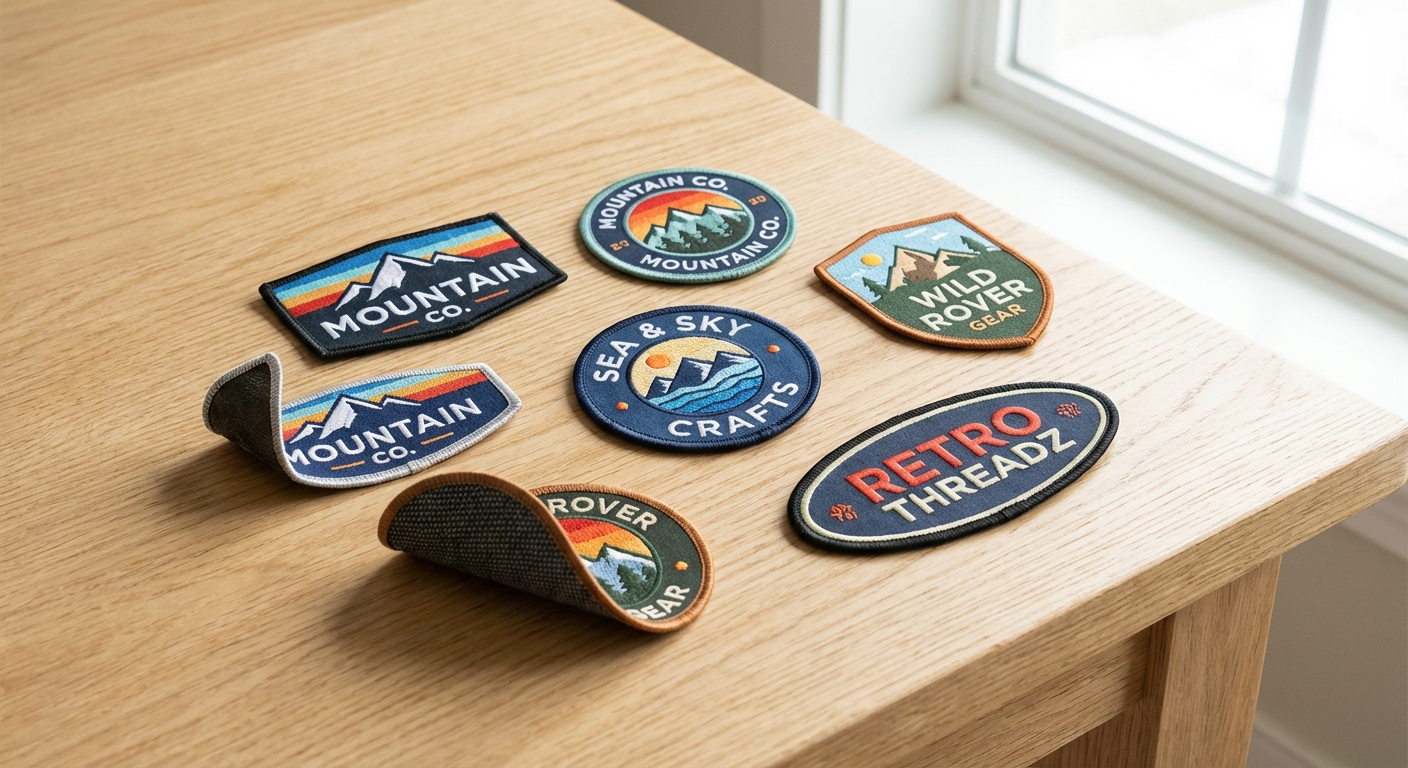
Mind your borders. Every woven patch needs a border. Typically a merrowed (overlocked) edge or a laser-cut edge is used. The merrowed edge adds about 1-2mm around the entire patch. Laser-cut gives a cleaner, more modern look with no visible edge thread. Both are standard options at no extra cost. Make sure your design has a small margin (at least 1mm) between the artwork and the edge to prevent cropping.
Choose a background color intentionally. The patch background color fills all the space your design doesn't occupy. White backgrounds show dirt easily. Black backgrounds hide detail. A background that matches your garment color helps the patch blend in; a contrasting background makes it pop. Think about what the patch sits on, not just how it looks in isolation.
Vector files are ideal but not mandatory. Our team can work with most file formats as long as the resolution is high enough. But vector files (AI, EPS, SVG, or PDF with fonts converted to outlines) give us the cleanest starting point and reduce the chance of quality loss during the digitization process.
What to Expect When You Order
The process is fast and low-risk. Submit your design through our woven patches page. You'll receive a digital proof showing your design as a finished patch.Thread colors, border style, size, and backing type will all be confirmed. Approve the proof, and production starts. Standard turnaround is about 2-3 weeks.
Before your patches ship, we can send a photo of the actual finished product for your final sign-off. That step has saved countless headaches. Colors on screen and colors in thread aren't always identical, and it's better to catch a mismatch before 500 patches are in transit.
Minimums are 5 pieces. Five. That's intentionally low because we know small brands need to test before they scale. Order 5-10 patches to check the look and feel on your garments, get customer feedback, and then come back for a larger run when you're confident. No pressure, no minimums that force you into inventory you don't need yet.
If you're ready to see what a woven patch of your logo looks like, request a free quote and upload your design. Our art team will have a digital proof back to you within a day or two.
The information below is required for social login
Sign In
Create New Account