

At some point in every production cycle, a buyer or brand manager has to make a call: woven tags or printed tags? Both communicate the same essential information. Both can be sourced at production volumes. But they behave differently on the garment, they cost differently at scale, and they signal different things to the end customer.
This guide breaks down the practical differences so you can setup the right label before your next production run.
What Distinguishes a Woven Tag From a Printed Tag
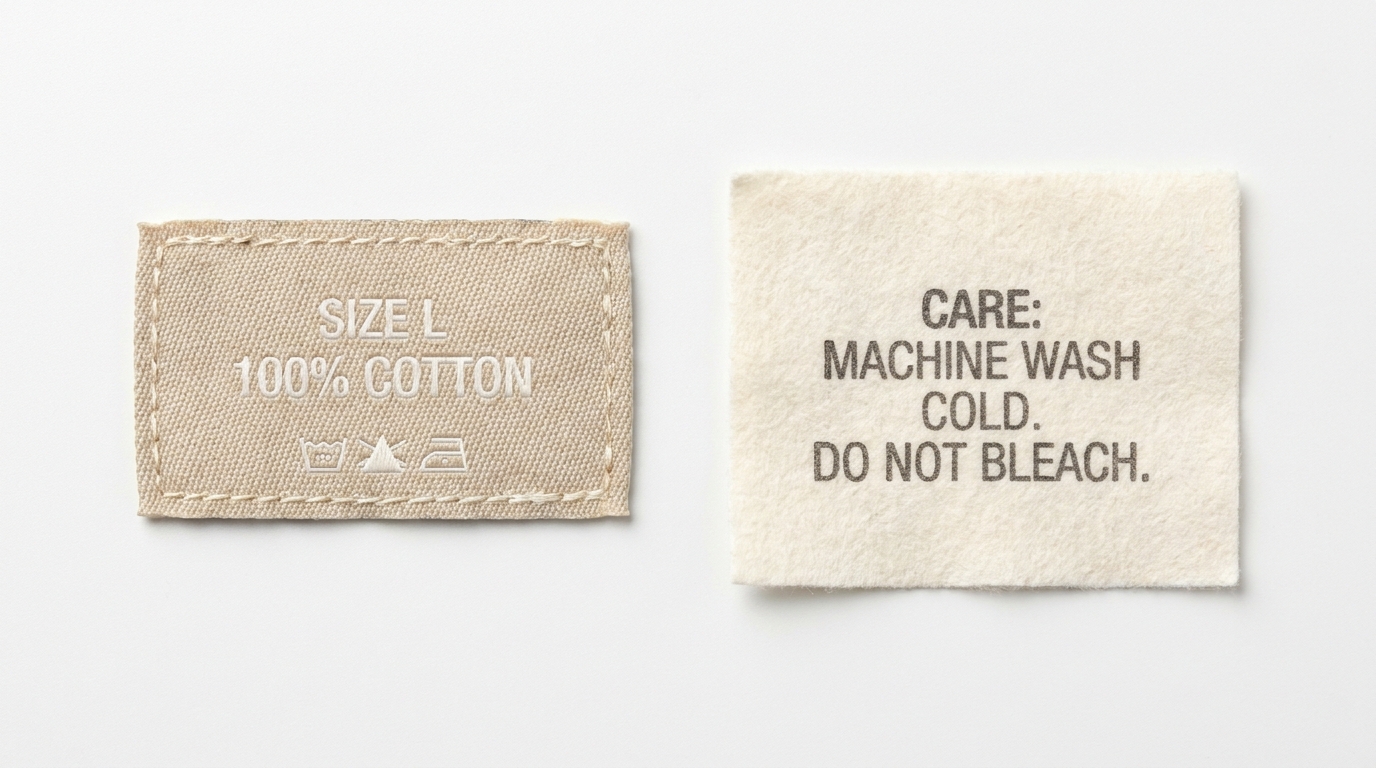
The core difference is how the information gets onto the label. A woven tag is constructed on a loom: the text, logo, or care symbols are woven into the fabric itself using colored threads. There is no ink. The result is a label where the content is structurally part of the material.
A printed tag works differently. The base fabric, usually cotton, polyester, or satin, is manufactured first, then the content is applied to its surface using dye sublimation or screen printing methods. The text and symbols sit on top of the weave rather than being part of it.
That distinction matters more than it sounds. It affects how the label holds up through repeated washing, how it reads after years on a garment, and how it feels against the skin.
Durability: What the Production Data Shows
Woven tags are built for longevity. Because the content is integral to the fabric construction, there is nothing to fade, peel, or crack. A well-made woven tag will outlast the garment it is sewn into. This makes them the default choice for outerwear, workwear, uniforms, and any product that will see industrial laundering or heavy use.
Printed tags hold up well under normal consumer washing conditions. A quality print on a dense cotton substrate can survive 50 or more wash cycles without significant degradation. Where they show wear sooner is under high-heat industrial washing, prolonged exposure to harsh detergents, or in garments that are washed daily. The ink surface, regardless of how well it is applied, eventually shows wear that the woven structure does not.
For brands producing high-volume basics, activewear, or any garment category where the label doubles as a care instruction that must remain legible, woven is generally the safer option. For fashion-forward pieces with shorter product lifecycles, printed tags often perform adequately at a lower unit cost.
Cost Structure at Production Volumes
This is where buyers often get surprised. The gap between woven and printed costs is not as large as most people expect once you are ordering in larger production quantities.
Woven tags typically carry a setup cost for programming the loom pattern. At low quantities, this setup cost per unit is significant. At Custom Woven Labels, we account for these setup costs and incorporate them into our pricing model. We do it this way so that we can offer the best pricing options for your project.
Printed labels have minimal setup cost and a lower cost per unit at very small quantities, which is why they suit short runs and sample orders. But they do not scale down in cost as aggressively as woven, because the substrate, printing, and cutting process has a cost floor that does not compress the same way loom production does.
The practical takeaway: if your run is under 1,000 units and cost is the primary constraint, printed cotton labels are typically more economical. Above 2,500 units, woven tags are often cost-competitive and deliver materially better durability. For regular reorders at production scale, most buyers end up going with woven options.
Minimum Order Requirements
Both label types start at 5 pieces at customwovenlabels.com, which makes sampling and prototype runs practical without committing to full production quantities. That said, the economics of each type only become favorable at different thresholds.
Our woven labels are designed specifically for production buyers who need clean, legible care and size information at scale. The format is straightforward: text and symbols on a woven substrate, folded and sized to your spec. These work across a wide range of garment types and are the standard choice when durability and a clean professional finish are both required.
Our printed cotton labels are the practical choice for brands that want a soft, natural-feel label at a lower unit cost, particularly for fashion lines, accessories, or any product where the label content is straightforward and the priority is comfort at the neckline or seam.
Comfort and Wearability
For brands selling directly to consumers, comfort is not a secondary consideration. A label that irritates the wearer generates returns and negative reviews. Both woven and printed labels can be made comfortable, but they require different design decisions to get there.
Woven labels can be scratchy if the thread ends are not properly finished. The standard solution is heat-cutting or ultrasonic cutting to seal the edges, or specifying a label that will be folded so the cut edges are tucked away from skin contact. A well-finished center-fold or end-fold woven label has no exposed edges and is comfortable against skin.
Printed cotton labels tend to be softer by default because the base substrate is a woven cotton fabric, not a dense polyester weave. They are a common choice for baby and childrenswear where skin sensitivity is a priority. The trade-off is that the print surface adds a slight texture, and some inks can feel less soft than a bare fabric surface.
If wearability is a major specification requirement, discuss it with your account rep before finalizing the label type and construction. Both formats can be made comfortable with the right finishing choices, and the options are not complicated once you know what to ask for.
Lead Time and Reorder Logistics
Both label types can be produced on standard lead times, typically 10 to 12 business days for production quantities. Rush options are available when your schedule requires it.
Where woven tags have a logistical advantage is in reorders. Once your loom pattern is programmed and your sample is approved, reorders run with the same setup. There is no re-proofing required for identical reorders, which matters when you are managing a tight production calendar. Printed labels also reorder efficiently, but have a higher chance of color variation between print runs. The variation in woven production, typically tends to be more consistent at scale.
For brands with ongoing production, this consistency factor is worth considering when choosing your label specification. A woven label that matches perfectly across three production runs is easier to manage than a printed label where you need to manage color drift between batches.
Which Format Fits Your Brand
There is no universal answer. The right choice depends on your product category, your volume, your quality expectations, and your cost targets.
Woven tags are typically the right choice for: outerwear, workwear, and uniform programs; garments that will be commercially laundered; any product where the label needs to remain legible and professional through heavy use; and brands where premium feel matters and the label is part of that signal.
Printed tags are typically the right choice for: fashion lines with shorter product lifecycles; accessories and soft goods where a lighter, softer label is a better fit; sample runs and first production orders where minimizing setup cost matters; and any category where the label will have minimal contact with skin and durability is less critical.
Many brands use both: woven labels for core, evergreen products and printed labels for seasonal or limited runs. Specifying both from a single supplier simplifies your procurement and keeps your label standards consistent across your product range.
Getting Your Spec Right Before Production
The most common mistake in label sourcing is finalizing the details too late. Labels are a long-lead item relative to how they are usually treated in production planning. If you are running a 10,000-unit order and the label is an afterthought in week six of an eight-week production cycle, you are creating a bottleneck.
The questions to answer early are: what information goes on the label (brand name, size, care, country of origin, fiber content), what is the attachment method (sew-in, heat applied), what is the size and fold type, and what is the quantity and reorder frequency. With those answers in place, you can get an accurate quote and a realistic timeline, and the label will not hold up your goods at the finish line.
Our team works with production buyers regularly and can turn around a quote quickly once you have the basic spec. Whether you need woven text labels for a uniform programme or printed cotton labels for a fashion line, we can get you from spec to sample without the back-and-forth that eats up lead time. Request a free quote at customwovenlabels.com and include your quantity, size, and content requirements to get an accurate number fast.
The information below is required for social login
Sign In
Create New Account